


Thank you for Subscribing to Med Tech Business Review Weekly Brief

Shanghai
Dr Hau-Tek KOH, Deputy Chief Medical Officer, Jiahui Health
5G-based Remote Surgery

Dr Hau-Tek KOH
In recent years, there has been focus on developing remote surgery in particular with the advancement of 5G technology and recently with COVID travel restrictions.
The difficulties of a medical procedure usually exist in the following points: High operational requirements, many changes in circumstances, and the pursuit of timeliness. In the field of surgery, it has been reported that widespread surgical procedures are not provided globally due to a lack of trained professionals, and besides the invention & implementation of laparoscopic surgery, most surgeries remain technically traditional and still performed as they were a hundred years ago. In 1994, Simon forecasted that the future of surgery in the 21st century will be characterized by an increased distance between the patient and the surgeon. One step in this trend was the introduction of robotic surgery; however, it has not passed the threshold to be adopted as a gold standard in most clinical situations. Chinese technological advancements in the 5G space have been faster, greater coverage and more developed than in many other countries, providing a country-wide connectivity platform for remote surgeries to be safely performed. In this article, technical requirements for remote surgery, 5G-based remote surgery and other applications in China, and the following challenges will be outlined. Technical requirements Some researchers have tried to perform remote surgery 20 years ago and proved that the technical requirements to separate the surgeon from the patient side already existed then. Marescaux (2001) performed a safe and uneventful cholecystectomy on a woman in Strasbourg, France, using the ZEUS robotic system. The extraordinary feature of this case was that the procedure was performed from New York City, United States, 6000 km away from the patient’s bedside. To do so, a trans-atlantic fiber optic connection was established. This connection enabled the use of a guaranteed bandwidth of 10 Mbit/s for both the robot motion and video data. A latency of 155 ms was measured, thereby ranging under a safe latency threshold of 300 ms. However, the total cost for the medical and technical staff, the surgical robot and the Internet connection exceeded USD 1 million. This study also showed that, in remote surgeries, the internet plays a fundamental and critical role in the operating room, even if some fine touch adjustments were needed in matters of bandwidth, latency, and costs at that time. Implementation of 5G Some of the possible features and applications still sounded far away. However, the global implementation of 5G has already begun. To play a role in surgery where high precision and reliability are an unquestionable requirement, the evolution of the Internet to 5G (5th generation mobile network) seems to be the promising and necessary surgical tool in the operating room that will ultimately avail the existing innovations of surgical technologies. Tian performed 12 cases of remote spinal surgeries on humans with lumbar spinal disorders using a surgical robot (TiRobot system) and 5G network. With peak data rates up to 100 times faster than 4G, 5G networks will able to support the growing number of connected devices globally, including fitness-tracking watches, internet-linked televisions and smart speakers at home, as well as apps based on augmented and virtual reality technologies. The key requirements for remote surgery are a high bandwidth with a fast data transfer and without delays. 5G mobile networks meet these requirements. With a data rate in the gigabit range, the necessary bandwidths of 7 Mbit/s are easily met. The same applies to the necessary latency for remote surgery, which has been defined as below 300 ms. 5G offers a 1 ms latency and therefore represents a huge 300x improvement for this crucial aspect in surgery. With its high speed, low latency and wireless transfer, multi-connectivity between multiple devices or users is possible, and can respond in real-time in surgeries. The first 5G-based remote human surgery On March 16, 2019, China’s first 5G-based remote human surgery - Parkinson's disease "brain pacemaker" implantation surgery was successfully completed in the Hainan Hospital of PLA General Hospital (PLAGH). In this surgery, Dr. Ling Zhipei, Chief neurosurgeon of Hainan Hospital of PLA General Hospital, completed the "brain pacemaker" implantation surgery for a patient in Beijing through high-definition video images transmitted by China Mobile's 5G network in real time. Dr Ling, who rotates between PLAGH main campus in Beijing and PLAGH’s Hainan Hospital 3,000 kilometers away, performed the delicate surgery in about 3-hours.Since then, there have been similar surgeries taking place throughout China. “With 5G, doctors can remotely check patients’ vital signs in real-time and pursue immediate action,” said Fei Hongwen, vice-director of assistive diagnosis at the Guangdong Provincial People’s Hospital, in a statement. “It helps provide more time (for health care professionals) to treat patients, instead of (being burdened with) commuting between hospitals.” "With the growing technological application of mobile internet, 5G and other technologies in the medical field in China, telemedicine service programs are expanding." Like in the above mentioned cases, remote surgery can serve areas which are geographically difficult to access, or simply generated savings for long-distance travel and costs. Hence, the expertise of specialized surgeons can still be accessed from far away. Furthermore with the current COVID-19 pandemic ongoing, minimizing transmission of infectious diseases or avoiding dangerous environments is more relevant than ever. 5Gtechnology adoption for healthcare in China A systematic literature review showed many studies used a 5G network provided by Huawei. Huawei is a Chinese company, and it is the largest 5G technology provider worldwide, far beyond other providers, and as mentioned earlier, by 2020,China has already built more than 500,000 5G base stations and 100 million networked devices. The Guangdong provincial hospital group is among a group of institutions that are working with telecommunications network operator China Mobile and infrastructure supplier Huawei Technologies to develop a range of applications with 5G on the Chinese mainland. This healthcare 5G collaboration supports more initiatives in telemedicine consultations, remote surgeries and smart hospitals across China, where quality healthcare services common in urban areas are also being made available in the far-flung rural areas, as well as for clinical emergencies in which patients in critical conditions cannot be easily moved to another location for treatment. With the growing technological application of mobile internet, 5G and other technologies in the medical field in China, telemedicine service programs are expanding. Currently, telemedicine service items include but are not limited to teleconsultation, teleclinic, 2-way referrals, remote pathology diagnosis, remote imaging, etc. Teleconsultations and remote surgery guidance have become typical application scenarios for the integration and development of 5G technology and telemedicine. Furthermore, 5G technology is also playing a more significant role in the development of remote imaging, pathology diagnosis and emergency rescue services (See figure 1).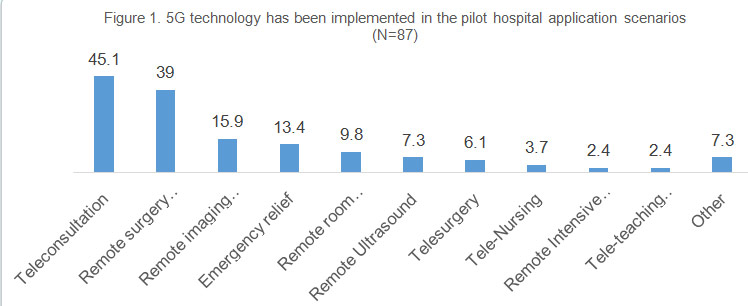 Challenges of remote surgery
Challenges do exist, despite the great potential applications of the technological and infrastructure advancements in modern China. In remote areas i.e. Usually rural and low-income areas, some will not have the means to afford this advanced technology. It was estimated that the network expansion of 5G in a country of size and economic status similar to Germany’s would cost tens of billions of Euros. Due to the high costs establishing such a technical system like robotic surgery with 5G, extending financial support or funding by the government is needed.
The current 5G technology faces not only constraints from the technology side, but also the improvement of moral and legal and ethical related supporting measures. On March 21, the National Health and Wellness Commission of China held a press conference, and Jiao Yahui, Deputy Director of the National Health and Wellness Commission's Medical Administration, said that for the application of 5G technology in the medical field, scientific and prudent exploration based on current network technology and the laws of medical science should be followed. Jiao Yahui has said that 5G is still a new development, the national backbone network is in different stages of development, which has some risk of instability in transmission between cross-regions, and there is still a gap between the actual rate and the expected theoretical rate of transmission. Teleconsultation over current 5G network in China does not carry much risk, but in surgeries, fault tolerance rate is very low, whether major surgery or a minor surgery. This clear risk exists, using 5G technology to perform remote surgery, as "once the network technology has failure and problems, you cannot say that the surgery is interrupted". 5G surgery involves issues of ethics and liability definition. Even if the risk control is minimized in the early stage, all surgical procedures have risks, and in case of a clinical accident, how do we determine and define the responsibility of the surgeon, the guide and the technology provider
Additionally, if remote surgery is applied across countries’ borders, 5G in surgery is not just a topic of medicine. It is a global, political issue which needs to be discussed from a political point of view as well. Recommendations and laws regarding how to handle this new technology in a practical but safe manner in medicine need to be addressed, and these laws cannot simply follow the geographical boundaries of states. One of the major advancements of the internet is global networking, enabling the advancement of remote surgery with 5G regardless of countries’ boundaries, but legal and ethical frameworks must be established on an international level.
Nevertheless, the use of 5G-based enabled remote surgery is moving modern surgery to an exciting next phase, removing the physical barrier with much hope that larger countries can greatly benefit their respective domestic populations.
Challenges of remote surgery
Challenges do exist, despite the great potential applications of the technological and infrastructure advancements in modern China. In remote areas i.e. Usually rural and low-income areas, some will not have the means to afford this advanced technology. It was estimated that the network expansion of 5G in a country of size and economic status similar to Germany’s would cost tens of billions of Euros. Due to the high costs establishing such a technical system like robotic surgery with 5G, extending financial support or funding by the government is needed.
The current 5G technology faces not only constraints from the technology side, but also the improvement of moral and legal and ethical related supporting measures. On March 21, the National Health and Wellness Commission of China held a press conference, and Jiao Yahui, Deputy Director of the National Health and Wellness Commission's Medical Administration, said that for the application of 5G technology in the medical field, scientific and prudent exploration based on current network technology and the laws of medical science should be followed. Jiao Yahui has said that 5G is still a new development, the national backbone network is in different stages of development, which has some risk of instability in transmission between cross-regions, and there is still a gap between the actual rate and the expected theoretical rate of transmission. Teleconsultation over current 5G network in China does not carry much risk, but in surgeries, fault tolerance rate is very low, whether major surgery or a minor surgery. This clear risk exists, using 5G technology to perform remote surgery, as "once the network technology has failure and problems, you cannot say that the surgery is interrupted". 5G surgery involves issues of ethics and liability definition. Even if the risk control is minimized in the early stage, all surgical procedures have risks, and in case of a clinical accident, how do we determine and define the responsibility of the surgeon, the guide and the technology provider
Additionally, if remote surgery is applied across countries’ borders, 5G in surgery is not just a topic of medicine. It is a global, political issue which needs to be discussed from a political point of view as well. Recommendations and laws regarding how to handle this new technology in a practical but safe manner in medicine need to be addressed, and these laws cannot simply follow the geographical boundaries of states. One of the major advancements of the internet is global networking, enabling the advancement of remote surgery with 5G regardless of countries’ boundaries, but legal and ethical frameworks must be established on an international level.
Nevertheless, the use of 5G-based enabled remote surgery is moving modern surgery to an exciting next phase, removing the physical barrier with much hope that larger countries can greatly benefit their respective domestic populations.
The articles from these contributors are based on their personal expertise and viewpoints, and do not necessarily reflect the opinions of their employers or affiliated organizations.
